 Nuvo Platform
 Nuvo Intelligence
 Customer Onboarding
 Portfolio Management
 Vendor Onboarding
 Accounts Receivable
 Alcohol & Beverage
 Apparel
 Building Materials
 Chemicals
 Distribution
 Food Service
 Heavy Equipment
 Manufacturing



Loading

Money your customers owe you isn't cash until it lands in your account. Until then it sits on the balance sheet as accounts receivable (AR), and how well you manage that gap determines whether your cash flow is predictable or a monthly guessing game.
When AR management slips, the symptoms are familiar. Invoices age past their due date, collections become a scramble at month-end, and you find out an account is in trouble only after it shows up in the aging report—and this is unfortunately common. In North America, 43% of B2B credit sales are paid late, according to the Atradius 2025 Payment Practices Barometer, and bad debts affect roughly 5% of long-outstanding invoices.
Strong accounts receivable management keeps that from happening. It covers the full path from extending credit to collecting cash, and if run well, it keeps working capital moving and gives finance a reliable read on what's coming in and when.
Accounts receivable management is the full process of extending credit to customers, invoicing them, collecting what they owe, and reconciling those payments. It starts the moment you let a customer buy on terms and ends when the cash is in your account and matched to the right invoice.
It's easy to file AR under billing, but that undersells what it does. Every dollar of receivables is credit you've extended, which makes AR a risk function as much as a revenue one, and your working capital is shaped by:
AR management runs as a connected cycle where each stage sets up the next. A weak handoff early on, like a customer onboarded without verified payment details, creates friction at every stage that follows.
The cycle starts before the first invoice, when you bring a new customer on and decide what credit to extend. You verify the business is who it says it is, evaluate its creditworthiness, and set a credit limit and payment terms you're comfortable with.
Most AR guides start the cycle at invoicing and treat onboarding as a footnote. The decisions you make at onboarding, including how much credit to extend, to whom, and on what terms, determine how much of your downstream collections effort you've signed up for. Onboarding is also where you should capture payment authorization and set the customer up correctly in your ERP, so ordering and billing run cleanly.
Once a customer is approved, you invoice them for goods or services delivered. A complete invoice carries:
The payment terms you set, such as Net 30 or Net 60, define when payment is due and shape your DSO directly. Invoice promptly, because the clock on debt collection doesn't start until the invoice goes out, and accurately, because errors trigger disputes and disputes stall payment.
Collections secure payment on invoices as they come due and follow up on the ones that don't. Effective collections is proactive and segmented rather than a uniform monthly sweep of every overdue account, with reminders going out before the due date and outreach tailored to the account.
A consistent follow-up cadence is what separates teams that collect on time from teams that react to overdue notices with:
A strong credit control process ties collections back to the limits and terms you set at onboarding, so a customer drifting past terms triggers a response instead of sliding.
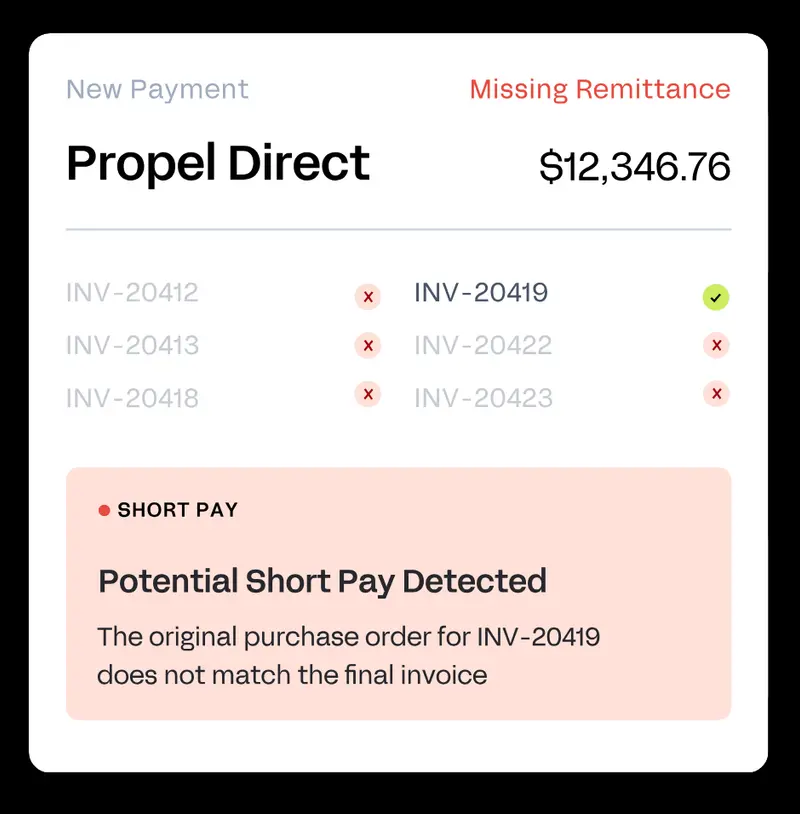
The final stage is matching incoming payments to the right open invoices and posting them to your ledger. This is cash application, and it's where a lot of AR teams lose hours when payments arrive without clear remittance detail, customers pay in batches, or a payment comes in short. Until a payment is matched and posted, your AR balance and aging report are both wrong.
A handful of metrics tell you whether the process is working and where it's breaking down. Track them consistently and you'll see problems forming before they hit cash.
Days sales outstanding (DSO) measures the average number of days it takes to collect payment after a sale. It's the headline AR metric because it translates directly into how fast receivables become cash. You calculate it by dividing accounts receivable by total credit sales over a period, then multiplying by the number of days in that period.
A "good" DSO depends on the terms you offer. If you sell on Net 30, a DSO of 35 days is healthy, while 55 days means customers are paying weeks past terms on average. The figure that matters is yours, measured against your own terms. A DSO climbing month over month is an early warning that collections are slipping or that you're extending terms you can't enforce.
An accounts receivable aging report groups your open invoices by how long they've been outstanding, typically in buckets such as current, 1 to 30 days past due, 31 to 60 days past due, 61 to 90 days past due, and 90+ days past due. It's the clearest single view of where your collection risk is concentrated. The longer an invoice goes unpaid, the less likely you are to collect it in full, so an invoice 90 days past due warrants a different response than one a week late. How balances move across the buckets tells you whether your collections effort is keeping pace.
Bad debt is the share of receivables you write off as uncollectible, and it’s the metric that confirms risk has turned into a loss. Tracking it as a percentage of sales tells you whether your credit and collections process is catching problems early enough.
Collection effectiveness rounds out the picture by measuring how much of what was available to collect was actually collected. Read alongside DSO and aging, it tells you whether your team is working the accounts that move cash.
Healthy metrics come from a few disciplined practices applied consistently. The difficulty is keeping them tight as volume grows and the manual work piles up.
That last point is where most of the manual work hides. When onboarding, invoicing, collections, and cash applications don't share data, your team spends its days moving information between systems, re-keying records, and reconciling reports that should already agree. AR automation removes that work by capturing customer and payment data once at onboarding, applying your credit rules automatically, and matching payments to invoices without manual keying.
Strong AR management is a process and a system, not a heroic month-end push. When the work depends on a few people knowing which accounts to chase and which spreadsheet holds the real numbers, it holds until volume doubles or someone leaves. A process that scales is connected across the full cycle, so growth doesn't add manual effort in proportion.
Connected accounts receivable management software changes the math here. Nuvo runs accounts receivable as one workflow, from customer onboarding through cash application, with each stage drawing on the customer context established upstream. It maps onto the same cycle:
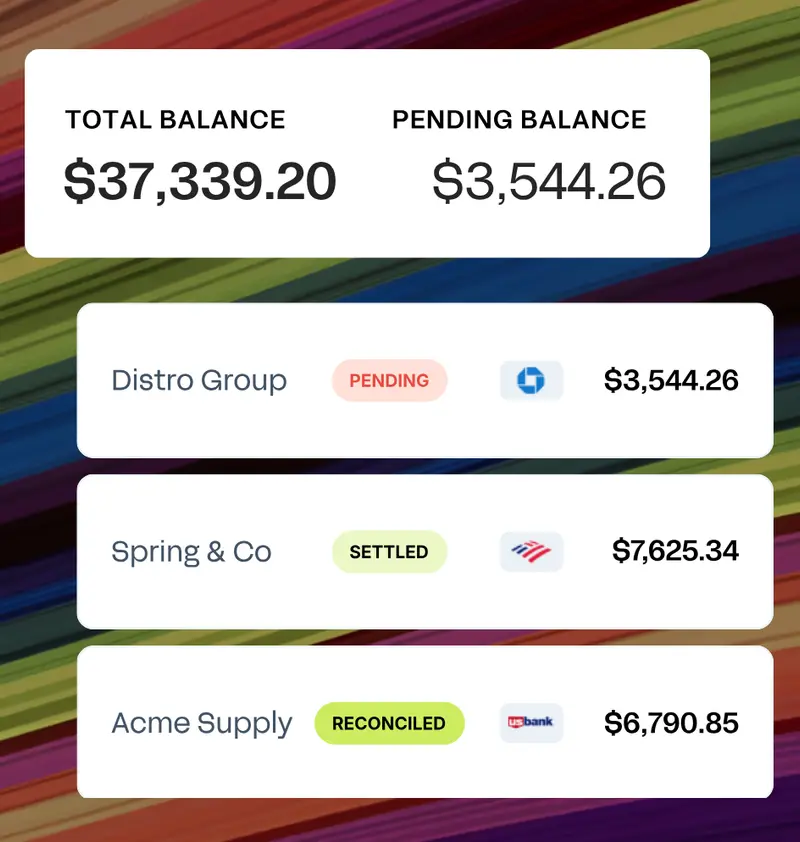
Customers running on the Nuvo Suite report a consistent pattern: lower DSO, with statistically significant reductions inside the first quarter, more predictable cash flow as reconciliation happens when payments land rather than weeks later, and AR teams that stop scaling headcount as routine cash application, dunning, and exception follow-up move to the background.
Risk doesn't stop at approval either. Nuvo's risk management monitors accounts continuously, pulling signals from banks, bureaus, and your own AR data into an action queue sorted by severity, so a customer whose risk profile shifts surfaces before the exposure shows up in your aging report.
See how Nuvo can help you manage receivables as one connected process, from credit approval through cash application, and keep cash flow predictable without the month-end fire drills.
The accounts receivable management process is the full cycle of extending credit, invoicing, collecting payment, and reconciling cash. It starts at customer onboarding, where you verify the business and set credit terms, then moves through invoicing on agreed terms, collections and follow-up on outstanding balances, and cash application, where payments are matched to open invoices and posted to your ledger. Each stage feeds the next, so a clean handoff early keeps the later stages running without friction.
A good DSO depends on the payment terms you offer rather than a universal benchmark. If you sell on Net 30, a DSO around 35 days is healthy, while 55 days means customers are paying weeks past terms on average. The number to watch is your own, measured against your terms and tracked over time. A DSO climbing month over month signals that collections are slipping or that you are extending terms you cannot enforce.
Improving accounts receivable management comes down to a few disciplined practices applied consistently: set a clear credit policy and apply it to every account, invoice promptly and accurately, and follow up on a set cadence with reminders before the due date. The larger gain comes from connecting your systems so credit decisions, customer data, invoices, and payments share one source. That removes the manual re-keying and reconciliation where AR usually slips as volume grows.