 Nuvo Platform
 Nuvo Intelligence
 Customer Onboarding
 Portfolio Management
 Vendor Onboarding
 Accounts Receivable
 Alcohol & Beverage
 Apparel
 Building Materials
 Chemicals
 Distribution
 Food Service
 Heavy Equipment
 Manufacturing



Loading

A credit application lands in your inbox. You email references, pull a bureau report manually, cross-reference payment history in a spreadsheet, and loop in sales days later with a decision. Meanwhile, the customer has already moved on, or your competitor said yes first.
Manual credit reviews cost you deals. Every approval that takes three days instead of three hours is a customer you lose to someone else. Every disconnected system and bottleneck slows down your cash flow and accounts receivable management.
Credit management software closes that gap by automating the repetitive work, surfacing credit risk management signals before they become bad debt, and connecting your credit approval decisions to the systems your sales and finance teams already use.
Here are five of the strongest platforms available right now.
Some solutions are purpose-built for B2B credit operations, while others sit inside broader order-to-cash suites. Your fit depends on whether you need a standalone platform, how critical ERP integration is, and whether you're solving for decisioning speed, portfolio monitoring, or the full onboarding-to-approval workflow.
Nuvo is a unified platform that connects customer onboarding and risk management in a single workflow. It's built for B2B companies that want to eliminate manual handoffs between sales, credit, and finance without sacrificing control over risk exposure.

Limitations: Purpose-built for B2B trade credit, not consumer lending. An initial configuration is required to map your credit policy rules and connect existing systems.
Best for: Mid-market and enterprise B2B companies that want to replace fragmented credit processes with one platform handling everything from application to approval. Nuvo is trusted by over 100,000 companies that need one connected system instead of five disconnected tools.
HighRadius offers an AI-powered credit management system as part of its broader order-to-cash suite. It's designed for high-volume operations that need automated decisioning tightly integrated with collections, cash application, and deductions management.
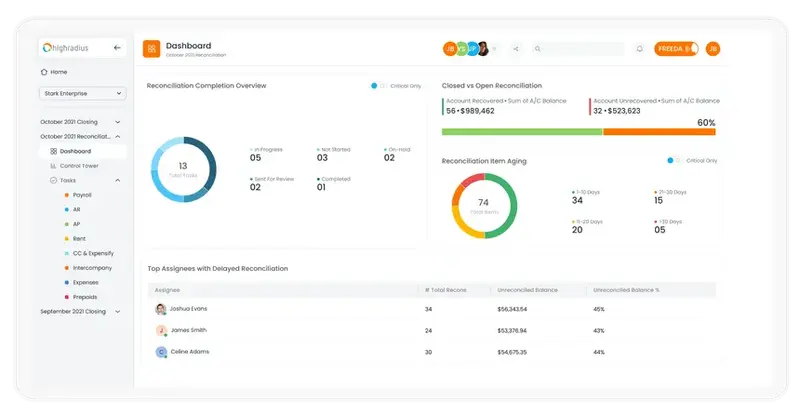
Limitations: Credit Cloud is available standalone, but pricing skews toward enterprise budgets and can feel heavy if credit management is your only need. Implementation timelines frequently stretch three to six months.
Best for: Large enterprises with complex O2C operations that need credit management integrated with the full receivables cycle and already have or plan to adopt HighRadius broadly.
Esker provides cloud-based credit management as one module within its broader AR automation platform. If you're already using Esker for invoicing or collections, adding the credit module creates workflow continuity across the cash cycle.
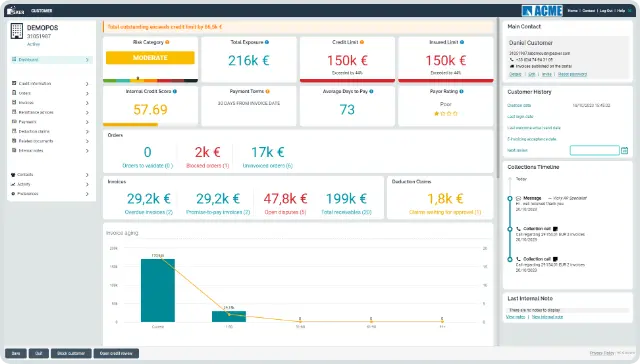
Limitations: Esker sells its O2C modules à la carte, so Credit Management can be bought on its own, but the platform is built for enterprise-scale operations, which can feel heavy for mid-market teams that just need lightweight credit decisioning.
Best for: Companies already using Esker for AR automation who want to centralize credit decisioning within their existing platform, or enterprise organizations pursuing a comprehensive O2C overhaul.
Billtrust's credit management solution sits inside its broader AR automation platform, connecting credit application intake directly to invoice delivery and payment collection workflows.
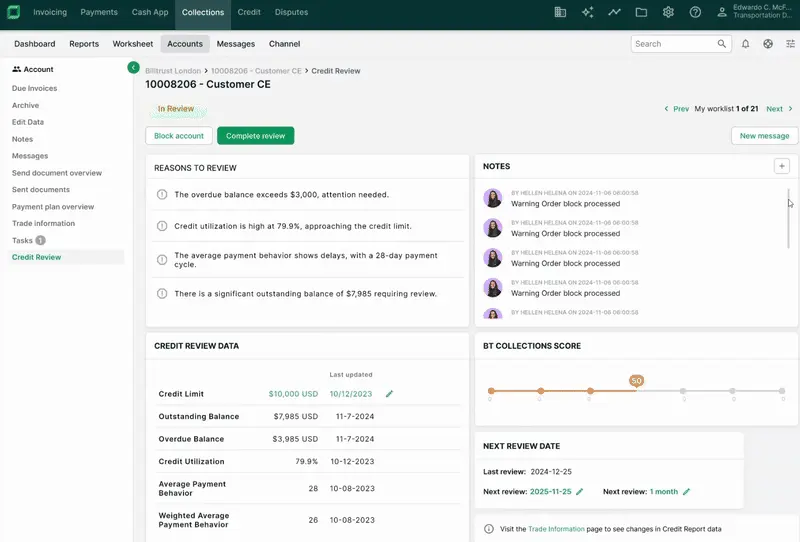
Limitations: Credit features work best inside the full Billtrust AR suite. Customization options for credit policies and approval workflows can be limited compared to standalone platforms, which matters if your business has non-standard credit rules.
Best for: Mid-market and enterprise companies already using Billtrust for AR automation who want credit decisions centralized within their existing O2C workflow.
Bectran is a dedicated B2B credit management platform covering the full credit-to-cash cycle: application intake, decisioning, AR automation, and collections in one system.
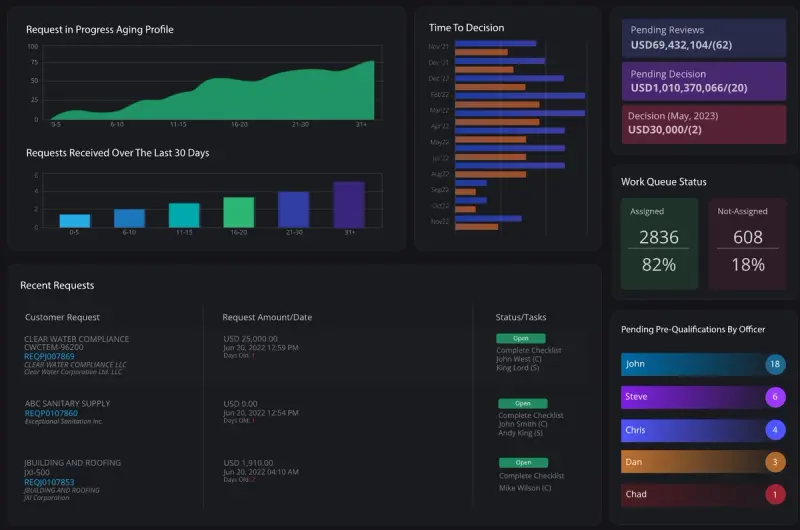
Limitations: Bectran covers so many workflows that configuration can get complex when migrating from legacy systems or building non-standard credit policies. The breadth of capability in a single UI can also feel dense for teams that only need credit decisioning.
Best for: Mid-market and enterprise B2B distributors and manufacturers that want to consolidate credit processing, monitoring, and collections under one roof and have the resources to support a comprehensive implementation.
Automation claims are cheap. What matters is whether a platform eliminates your actual bottlenecks or just moves them around.
Manual reviews don't scale. When every application requires someone to pull reports, cross-reference payment histories, and loop in sales, approval times stretch into days. That delay costs deals.
Automated decisioning changes the math. You define rules once around credit score thresholds, payment term limits, and cash flow exposure caps. The system applies them consistently across every application. Low-risk ones get approved instantly. Edge cases get flagged for review. High-risk applicants get declined before they consume your team's time.
The platforms that do this well layer in multiple data sources instead of relying on a single bureau score:
This builds a complete creditworthiness picture, which means fewer false declines and fewer bad approvals. Nuvo's B2B trade credit automation pulls from multiple data sources into a unified risk profile, so your decisioning rules work with complete information rather than whatever data points were easiest to integrate.
Approving a customer is one decision. Keeping them approved is an ongoing process. Payment behavior shifts. Financial health deteriorates. If you're only reviewing accounts quarterly or when something goes wrong, you're always reacting too late.
Effective monitoring tracks more than payment history. The best platforms flag payment pattern changes, credit utilization trends, external credit events like liens and judgments, and industry-level risk signals before they show up in your AR aging.
Instead of discovering a problem at your weekly AR meeting, you get an alert the day a customer's credit score drops or a new judgment gets filed.
Look for platforms that let you configure thresholds and escalation rules:
Alerts that sit in someone's inbox while risk compounds won't help. You need visibility connected to action.
If your credit management software doesn't talk to your ERP and CRM, you're running duplicate data that never stays current. Integration determines whether a platform actually speeds up operations or just digitizes the same bottlenecks.
The right system pushes approved credit limits into your ERP so sales can quote without waiting, pulls payment data to keep risk models current, and syncs customer records to eliminate duplicate entry.
Most platforms claim integration but deliver it through rigid APIs requiring custom development work. Nuvo's customer onboarding platform syncs with ERP and CRM systems so credit decisions, customer data, and risk signals flow without custom code.
When your credit software connects to your stack, approvals happen faster, data stays consistent, and your team stops wasting time moving information between systems.
Start by mapping your current pain points to specific platform functionality:
Quantify the cost of your current process. The evaluation framework that works is the one that forces you to put numbers on the status quo:
Those numbers tell you which features will matter versus which ones just look good in a demo.
Make vendors walk through your most complicated scenario, not their cleanest success story. Ask these questions:
The answers reveal whether the software will work with your reality or just add another system to manage around.
Don't skip the integration conversation. Most credit management software failures happen because the platform can't talk to your ERP or CRM without custom development. If the vendor can't show you how customer data, credit decisions, and payment history sync, you're looking at a tool that creates more manual work, not less.
Watch for these common evaluation mistakes:
The right platform eliminates manual bottlenecks. It gets credit decisions out faster, provides the visibility you need to approve without second-guessing, and connects the systems you already use so nothing falls through the cracks.
Before you book a vendor demo, audit your last ten credit decisions. Where did your team spend the most time? Where did data sit in someone's inbox? Where did the approval drag past your policy SLA?
If those answers point to manual follow-ups between sales, credit, and finance, learn how Nuvo connects onboarding and risk in one platform built for B2B credit management teams.