 Nuvo Platform
 Nuvo Intelligence
 Customer Onboarding
 Portfolio Management
 Vendor Onboarding
 Accounts Receivable
 Alcohol & Beverage
 Apparel
 Building Materials
 Chemicals
 Distribution
 Food Service
 Heavy Equipment
 Manufacturing



Loading

Every team has a credit policy. Not every credit team has it written down.
Those that do usually have two versions: the policy in the document, and the policy the veteran credit manager actually follows. Normally, that’s fine. It’s how institutional knowledge works. The documentation says one thing, but the person knows the real threshold. No need to update anything because that person is around to make the call.
But what happens when they leave? Or when AI agents enter the picture?
In our recent webinar, we asked attendees from credit, AR, and finance teams whether they have a documented credit policy. Just over half—52 percent—said yes, written down, and current. Thirty-five percent said yes, but it’s out of date. Eleven percent said no, policies mostly live in people’s heads.
At first glance, that last group is in danger. But the 35 percent will be hit hardest by change unless they plan ahead now.
Start with the best case scenario. If your policy is written down and current, you could hand it to ten new credit analysts tomorrow and they’d be able to make the hard judgement calls as you'd want them to. If that’s true, an AI agent could also handle those same instructions. The hard part—passing judgement to someone else—is already done.
When nothing is written down, you have a problem. But there’s nothing to unlearn. That’s useful. You can start from a blank page, and the pressure to automate is really just a forcing function to write down what you already know. Plenty of credit teams have needed that push for years.
But the out-of-date policy is the hardest. Mostly because it looks like a policy that’s ready to be put to use.
Maybe it’s a policy written in a different economy, or a different stage of growth, or perhaps two mergers ago. The policy likely describes different customers and different needs, and the parts that people have learned to skip are still written down. Teams can work around it all without much thought because they understand which rules are real. But an agent doesn’t which rules are real. So it applies every one it can see.
“Agents don’t just inherit the human operator’s instruction set. They amplify whatever mistakes or imprecisions exist in it,” says Sid Malladi, Nuvo’s Co-Founder & CEO. The question he then asks is: would you want that out-of-date policy applied a few thousand times a month?
Probably not.
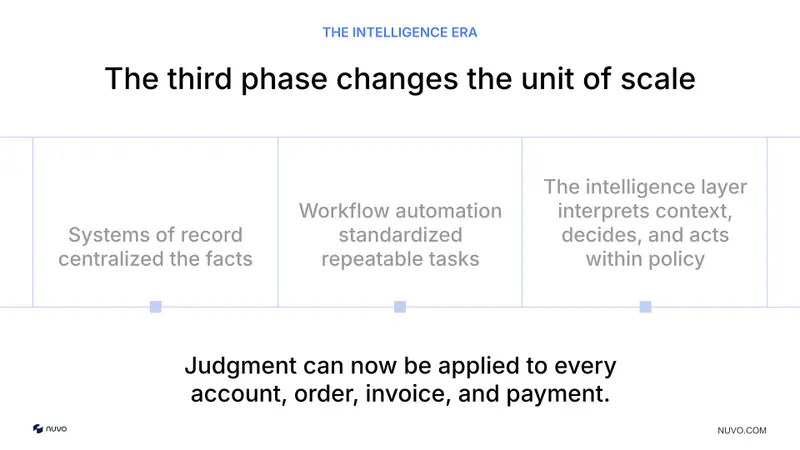
Think of the current era of credit as the third technology wave:
First, systems of record centralized facts. ERPs and CRMs gave you one place where things were tracked and written down. It solved the memory problem.
Next, workflow automation standardized repeatable tasks. If X, then Y. Workflows were rigid, but they worked, so every customer roughly experienced the same thing. The same applications, the same rules.
Now we’re in an era where the intelligence layer can interpret context and decide within a policy. An agent can read a bank reference, weigh it, and take a different action depending on the size of the account—because you told it how those cases differ.
So what ultimately decides whether things are put into action is whether you’ve written down how your business actually makes decisions.
Policies can be directionally right when written for humans, because people can read between the lines and make judgement calls. A policy ready for this new era of credit needs to be explicit about four things:
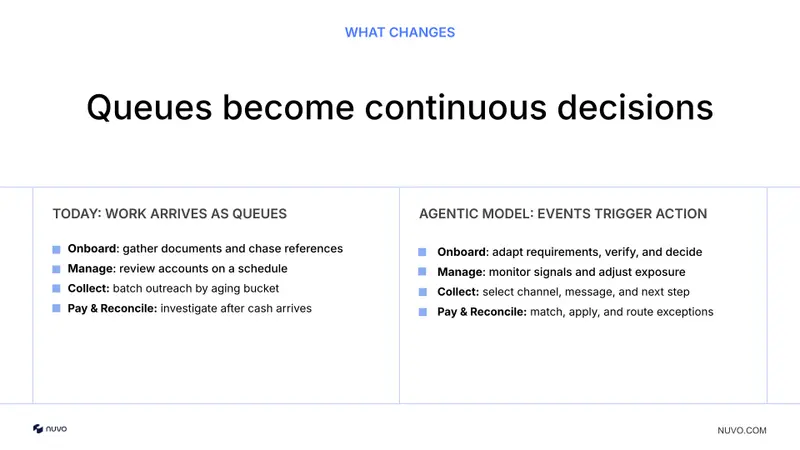
There’s plenty of conversation around AI taking over. But for credit teams, agents change what parts of the job are worth investing in more.
Deciding whether the strategic account that doesn’t quite fit is worth the exception. Or how to spot the pattern of late payments that should change a customer’s credit strategy. Or when a past-due account needs a phone call instead of another automated reminder. Those are policy-level, judgement decisions that aren’t about to be offloaded.
“Operators move from tactical executors to architects,” Sid says. “You’re the one with context about your business, your customers, your industry. What you become responsible for is designing the policies that are run by agents.”
That job needs people who know the ins and outs. But that job only works if the judgement is written down somewhere to be executed.
All this leaves a fairly uncomfortable question. Not whether you have a credit policy. Most teams do—somewhere. It’s whether the one you have could survive being handed to an agent that doesn’t already know what’s missing or what to skip.
Most can answer that quickly. Some need to double check the latest policy. That’s the big challenge, but it’s ready to be solved now.
Sid talked about this and a lot more in our recent webinar, The next five years for credit, AR, and finance, including what teams are doing now to get ahead of all this change. It’s available to watch on-demand, so click here to watch the full recording.