 Nuvo Platform
 Nuvo Intelligence
 Customer Onboarding
 Portfolio Management
 Vendor Onboarding
 Accounts Receivable
 Alcohol & Beverage
 Apparel
 Building Materials
 Chemicals
 Distribution
 Food Service
 Heavy Equipment
 Manufacturing



Loading

Your team spends the back half of every week the same way: Matching payments to recurring invoices by hand, opening remittance emails to figure out what a customer actually paid, and sending the same follow-up to the same accounts that were late last month and will be late again next month. The work gets done, but it eats the hours that should go to the handful of accounts that actually need a person looking at them.
Meanwhile, your days sales outstanding (DSO) doesn't move. Cash that should be in the bank sits in someone's inbox waiting to be applied. Forecasts are built on a snapshot that's already a week old by the time finance sees it.
Accounting software and accounts receivable automation is how you take that manual load off the team and redirect it. Done well, it doesn't replace the judgment calls. It clears away the repetitive work so your people can spend their time where judgment is actually required. To implement effectively, you need to know what AR automation handles, the benefits that show up on metrics your finance team owns, the use cases where it does real work, and how to get started.
Accounts receivable (AR) automation uses software and connected data for invoice generation, payment follow-ups, cash application, and reconciliation with far less manual input. Instead of pulling invoices into a spreadsheet, emailing reminders one at a time, and matching payments by hand, the system:
Automation changes what people spend their time on. It's good at the high-volume, rules-based parts of receivables, like:
What still requires a human touch is the work based on context and relationship, such as a disputed deduction tied to a damaged shipment, a key account asking for extended terms, or an escalation that could put a renewal at risk. These calls draw on history and negotiation, and they're exactly where you want your team's attention. A good automation setup reduces the noise so those conversations get the time they deserve.
These benefits should connect to a metric the finance team already reports on, which makes the return simple to measure.
Days sales outstanding (DSO) is where you see automation benefits most clearly. Invoices go out the moment an order ships and reminders fire on a set cadence instead of whenever someone remembers, so payment cycles compress. BILL reports that many businesses see payments arrive twice as fast after adopting AR automation, which translates directly into more working capital on hand. In fact, AFP, citing PYMNTS research, found that organizations with automation had an average DSO of 40 days, compared to 47 days for those without.
Manual follow-up is uneven by nature. The accounts that get followed up on are the ones a person happens to notice, and the rest drift. Automated reminders treat every overdue invoice the same way, so nothing slips because the team was busy.
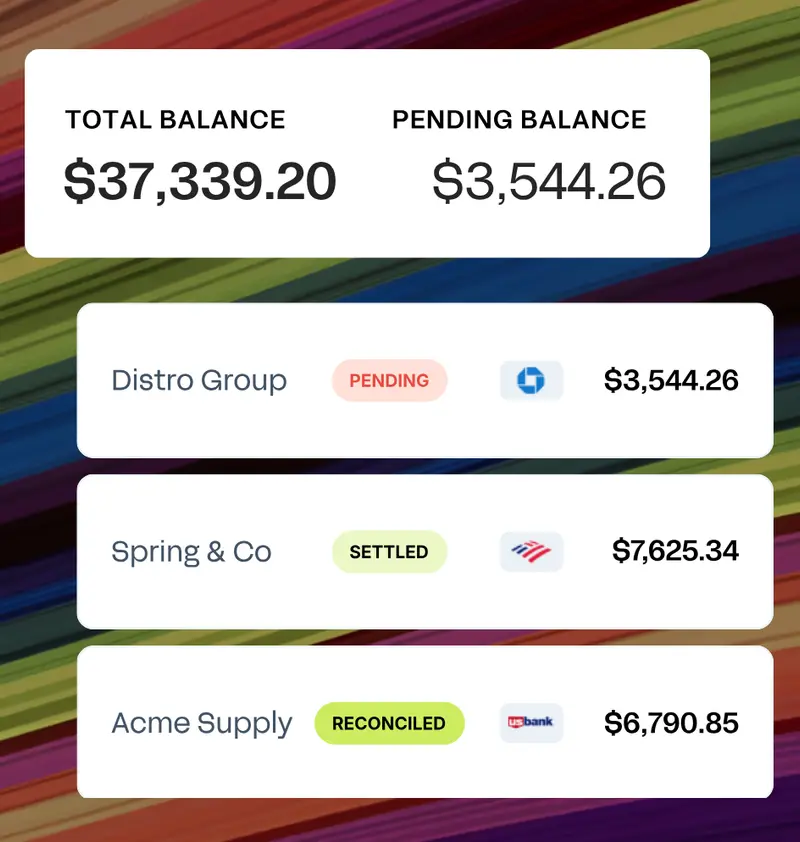
Manual cash application is where money goes to sit. A payment comes in without clear remittance, nobody can tell which invoices it covers, and it lands in an unapplied bucket until someone has time to investigate. Multiply that across hundreds of payments a month and a real slice of your cash flow is stuck in limbo, distorting both your AR aging and your customer's account.
Automation matches payments to invoices as they arrive by reading remittance documents, bank notifications, and customer emails. Clean matches post to the general ledger on their own, and only genuine exceptions reach a person. That keeps unapplied cash low and your ledger accurate, which means fewer customers getting dunned for invoices they've already paid.
A manual AR workflow gives you a view of receivables that's accurate as of the last time someone updated the spreadsheet. By the time it reaches the CFO, it's stale, and then cash forecasts miss.
Automated systems keep AR current because every invoice, payment, and status change updates in real time. Finance can see which invoices are open, overdue, or paid at any moment, and forecasts draw on live data instead of a week-old snapshot. Better visibility also feeds upstream into credit management, where current payment behavior should inform decisions about limits and payment terms.
Manual receivables scale linearly. Double your invoice volume and you eventually need to double the people processing it. That math is what makes growth feel like it's working against finance instead of with it.
Automation breaks the link between volume and headcount. The system handles automated invoicing, reminders, and cash application at any volume, so a growing book of business doesn't require a proportional increase in AR headcount. Your people manage exceptions and relationships, and the routine load scales on its own.
The benefits above come from a handful of concrete jobs automation takes over. Here's a closer look at where it does that work, framed as scenarios any finance team will recognize.
Invoices that go out late get late payments. When invoicing depends on someone manually pulling order data and sending a PDF, delivery slips, and the clock on every payment starts later than it should.
Automation generates and delivers invoices the moment an order is ready, then runs the reminder schedule on its own. Customers receive accurate invoices and timely follow-ups every cycle, and a self-serve portal lets them view balances, download past invoices, and pay without calling your team. That consistency is what turns scattered, reactive follow-up into a predictable collections rhythm.
Cash applications and payment matching are where automation frees up the most time. Reading a remittance, finding the matching invoices, applying the payment, and posting to the ledger is slow, repetitive, and easy to get wrong when the remittance is unclear or a payment covers multiple invoices.
Automated cash application is able to:
When remittance is missing, the system can scan for it and reach out to the customer rather than parking the payment as unapplied. As one breakdown of automatable AR tasks notes, keeping invoice status and payment confirmations synced across ERP, CRM, and reporting tools also reduces audit risk by giving finance, sales, and operations one source of truth.
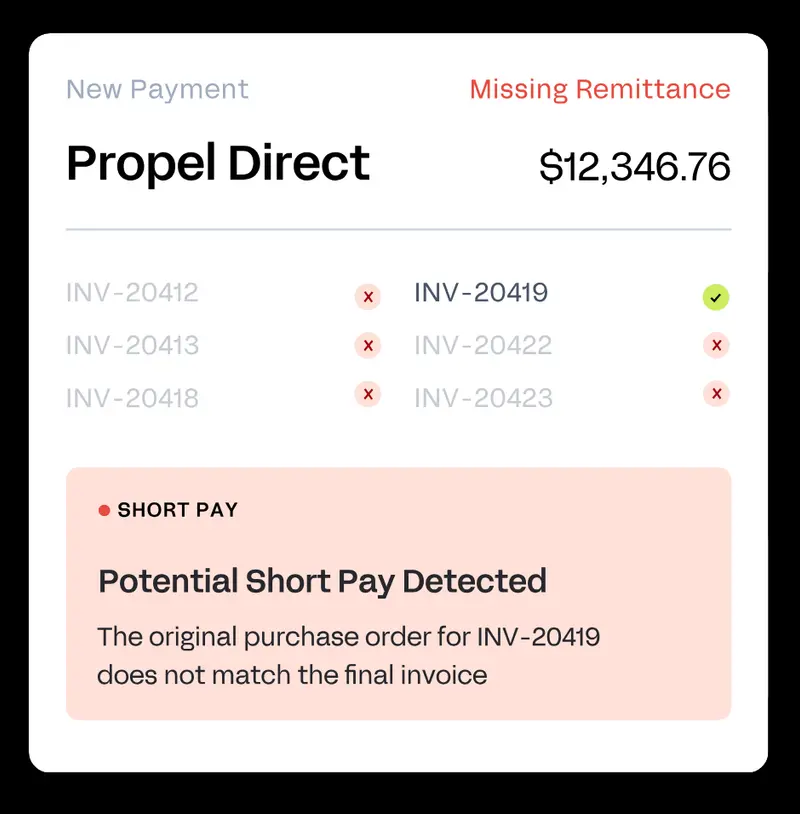
Deductions are where receivables get personal—and where they tend to stall. When a customer short-pays an invoice, someone has to figure out why, dig up the relevant history, and handle dispute resolution. Left alone, these disputes age and drag down your AR.
Automation handles the diagnostic legwork. It flags short pays, deductions, and disputes the moment they appear against an open invoice, then pulls customer history, prior dispute management, and purchase order context to surface the likely cause. A person still makes the call on a contested deduction, but they walk into that conversation with the full picture instead of spending an afternoon assembling it.
Not every overdue account deserves the same attention. A customer who's two days late and always pays is a different problem from one that's 45 days out with a deteriorating risk profile, but a manual data entry and process tends to treat them alike or chases whoever's top of mind.
Automated collections prioritize follow-up based on payment patterns, credit context, and relationship history, so your team's energy goes to the accounts that warrant it. The system drafts and sends dunning outreach with the tone, channel, and cadence your policy defines, and surfaces aging accounts with full context so a person can step in where a relationship is on the line.
You don't have to automate the entire receivables cycle at once. The fastest return comes from starting where the manual load is heaviest, proving it out, then expanding.
Where this gets more powerful is when receivables don't sit on an island. Nuvo runs onboarding, credit, and AR on shared data through Nuvo Intelligence agents, so the context built up at customer onboarding and during credit decisioning carries into how payments get collected.
Onboarding is where a customer authorizes payment methods that can be used for every future invoice, which means the AR work starts on solid footing rather than chasing authorization after the fact. Credit decisions draw on live payment history, and collections outreach reflects the full relationship rather than a single overdue line. Our overview of the AI-native order-to-cash network covers how those pieces fit together.
Manual receivables put a ceiling on growth. Every new customer adds invoices to match, reminders to send, and disputes to resolve, and at some point the team can't keep pace without more people. AR becomes the function that slows the business down.
Automating routine work changes that relationship. Collections speed up, unapplied cash drops, forecasts get sharper, and the team's capacity stops being tied to invoice volume. The goal is a receivables process that keeps pace with growth instead of throttling it, where your people spend their time on the accounts and decisions that genuinely need them.
With Nuvo's AR Suite, redirect the hours your team spends matching payments and reconciling remittance toward the accounts that need real judgment. It handles the work for you, mitigating potential errors and delays.
AR automation handles the high-volume, rules-based parts of the receivables cycle: generating and delivering invoices, scheduling and sending payment reminders, matching incoming payments to open invoices, posting clean matches to the general ledger, flagging short pays and disputes, and prioritizing collections follow-up.
It keeps AR data current across your systems in real time. Judgment-heavy work, like resolving a contested deduction or negotiating terms with a key account, still belongs to your team.
The main benefits tie directly to finance metrics. Automation lowers DSO by sending invoices and reminders on a consistent schedule, reduces unapplied cash by matching payments to invoices as they arrive, and improves forecasting by keeping receivables data current instead of relying on stale snapshots. It also lets you handle a growing volume of invoices without adding headcount because the routine work scales on its own while your team focuses on exceptions.
Mid-market companies do benefit from AR automation, as they often run enough invoice volume to feel the cost of manual receivables but lack the large AR team that masks it. Automation is especially valuable there because it removes the manual bottleneck without requiring proportional hiring as the business grows. The return shows up quickly in faster collections, lower unapplied cash, and capacity that scales with the customer base rather than against it.