 Nuvo Platform
 Nuvo Intelligence
 Customer Onboarding
 Portfolio Management
 Vendor Onboarding
 Accounts Receivable
 Alcohol & Beverage
 Apparel
 Building Materials
 Chemicals
 Distribution
 Food Service
 Heavy Equipment
 Manufacturing



Loading

Your credit and AR team spends hours every week matching payments to invoices, chasing remittance, resolving short pays, and following up on slow accounts. Meanwhile, earned cash sits uncollected.
Most teams already know which invoices are overdue. According to the Atradius 2024 Payment Practices Barometer, half of all B2B invoices in the US are paid late, and bad debts average 8% of credit sales. Accounts receivable automation software can move that routine work off your plate, freeing up working capital and improving cash flow.
But some platforms only handle one part of the cycle: payment reminders or card acceptance. Others run the full invoice-to-cash process, from payment receipt to GL posting. What a platform actually automates matters more than dashboard polish.
Nuvo is an AI-native order-to-cash platform built for distributors, manufacturers, and other physical goods companies. It captures verified payment methods and authorization at customer onboarding, before the first invoice goes out, so automated payments can run from the first transaction.
Once payments land, Nuvo Intelligence agents handle the receivables work. They parse remittance documents, bank notifications, and customer emails to match payments to invoices in real time, then post matched cash to the GL with ERP syncs, keeping balances current.

Key features:
Limitations: Nuvo is purpose-built for physical goods industries, so finance teams in software or services will find the fit less direct. The AR Suite is newer to market than the long-established enterprise platforms.
Best for: Distributors, manufacturers, and other physical goods companies that want onboarding, payments, and payment collection running as one connected process.
HighRadius is an enterprise order-to-cash platform covering cash application, collections, deductions, and credit across a wide module set, with the longest track record on this list for high-volume, multi-module deployments in enterprise accounting systems.

Key features:
Limitations: Built for enterprise complexity, which often means longer implementation timelines, steeper costs, and paying for modules a smaller team won't use.
Best for: Large enterprises with high invoice volume and the resources to run a multi-module platform.
Billtrust focuses on B2B invoicing, payments, and cash application, with an emphasis on getting invoices delivered and paid through the channels customers prefer, plus added AI features across its collections and cash application products.
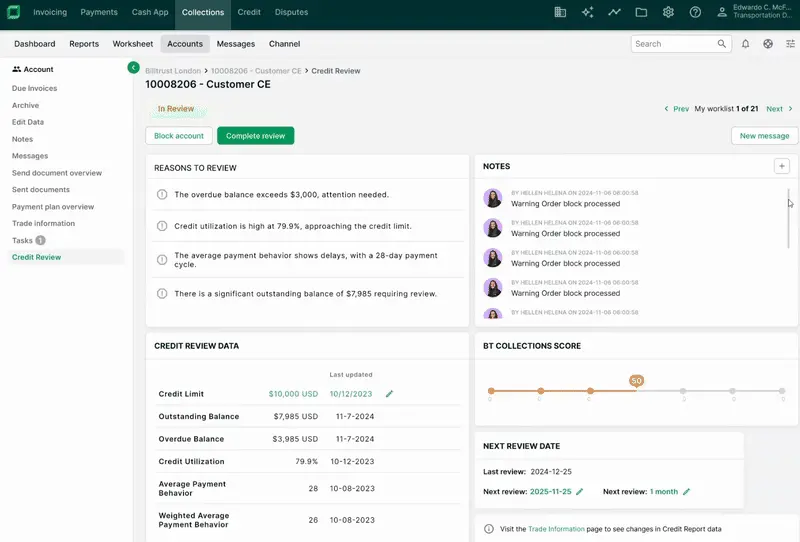
Key features:
Limitations: Strongest on the invoicing-to-payment side, so teams that need heavy credit decisioning or onboarding will look elsewhere for those steps, and pricing reflects a mid-market-and-up positioning.
Best for: Mid-market and enterprise B2B companies modernizing invoice delivery and payment acceptance alongside cash application.
Esker is a document-process automation company whose AR suite covers invoicing, collections, cash application, and deductions, and it's a common choice in SAP-heavy environments where its integration depth pays off.

Key features:
Limitations: Breadth across both AR and AP can mean more configuration to tune a single workflow, and the best value tends to land with larger, process-heavy organizations.
Best for: Larger organizations, especially SAP shops, wanting AR automation inside a broader document-process platform.
Versapay is built around collaborative AR, giving customers a shared portal to view invoices, raise disputes, and pay. The premise is that much late payment comes down to communication breakdowns, so it puts buyer and seller in the same place.
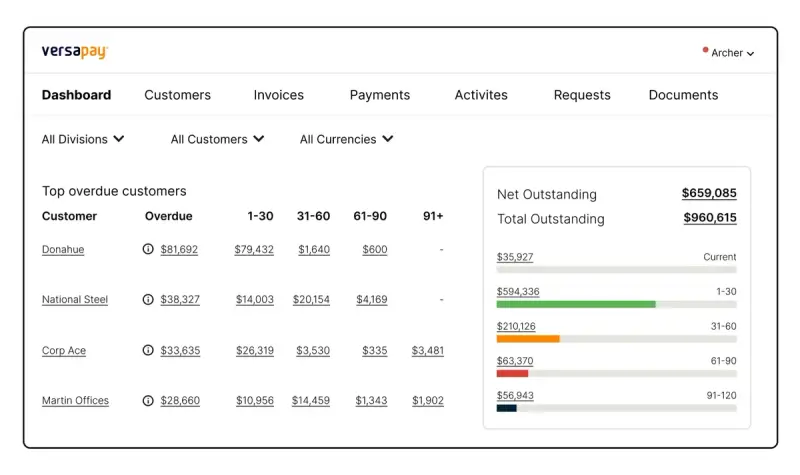
Key features:
Limitations: The collaborative model works best when your customers will actually engage with a portal, which varies by industry and buyer, and credit and onboarding sit outside its core focus.
Best for: B2B companies whose late payments stem from communication and dispute friction.
Quadient AR, formerly YayPay, centers on collections and AR analytics, with predictive analytics into when customers are likely to pay, layered on top of existing receivables data from common ERPs.

Key features:
Limitations: Strongest as a collections and analytics layer rather than a full order-to-cash system, so payments and onboarding may need separate tools, and cash application depth varies by configuration.
Best for: Teams wanting sharper collections prioritization and payment-prediction analytics on top of their current AR stack.
These platforms overlap on labels and diverge on substance. The capabilities below decide whether software removes work or reorganizes it, and the test for each is whether the platform acts on the data or only shows it to you.
Cash application eats up most manual data entry in AR time. Someone opens a bank notification, finds matching invoices, splits a lump payment across them, and posts it. Hundreds of times a month. Slower still when remittances are missing, or one payment covers a dozen invoices.
Effective software parses remittance documents, bank files, and customer emails to match payments automatically and post to the GL. The key differentiator is what happens when remittance is missing. Leading systems go after the missing detail by scanning inboxes and reaching out to customers for clarification.
Most collections software sends dunning on a schedule: reminders based on due dates. It's useful, but it applies the same cadence to every account. A customer who pays on day 35 every time doesn't need the same sequence as one whose behavior just shifted.
Effective collections automation prioritizes based on actual payment behavior and adapts outreach to the customer. When dunning runs automatically based on payment history, your team focuses on the accounts that need a real conversation. This focused follow-up improves days sales outstanding, converting overdue invoices to cash faster.
Short pays and deductions are the slowest part of cash application, because each one is a small investigation. A customer pays less than the invoice, and someone has to figure out why, whether a pricing discrepancy, a damaged shipment, or an unauthorized chargeback, then resolve it and post the corrected amount.
Look for software that flags a deduction the moment it appears, pulls the relevant history and PO context to diagnose the cause, and works toward a resolution rather than just logging the discrepancy. A platform that only records that a deduction exists has automated the easy part and left the hard part to you.
If your AR software doesn't post to your ERP automatically, you're maintaining the same data in two places and re-entering it by hand, reintroducing the manual data entry and errors the software was supposed to remove. Verify your system integrates with QuickBooks, Xero, NetSuite, Sage Intacct, or whatever accounting software you use.
The capability to confirm is straight-through posting: matched cash, resolved deductions, and updated balances flow into the GL without manual entry, and customer records stay in sync. Ask any vendor to show you the full posting step, not just the matching step, because the gap between "the system matched it" and "the system posted it" is where manual work hides.
Most AR tools demo well, because surfacing data in a clean dashboard is the easy part. A useful evaluation puts pressure on what happens after the dashboard:
For each capability, ask whether the platform completes the task or just shows you that the task needs doing. A collections dashboard that ranks overdue accounts is useful. An agent that sends the dunning and escalates the exceptions is what removes the work.
Put numbers on your current process:
Ask how the platform handles the cases that actually slow your team down:
Map how matched cash, resolved deductions, and updated balances reach your ERP. If the vendor can only show you the matching step and not the posting step, you're looking at a tool that creates reconciliation work rather than removing it.
For physical goods teams, Nuvo Intelligence is built around that test. Agents match payments, resolve deductions, post cash to the GL, and run dunning, handing your team only the accounts that need judgment.
When evaluating software, focus on what the system actually completes. Can it match and post cash automatically? Resolve deductions? Run payment collection outreach without human intervention? Enforce PCI DSS and provide audit trails?
Before you demo, pull your last month of AR work and identify which steps require manual touch. The platform that automates most of those steps, all the way through to a posted entry, is the one that removes actual work and improves both DSO reduction and cash flow.
Put the routine receivables work on autopilot with agents that match payments, resolve deductions, and post cash to your GL, so your team handles the accounts that need judgment. See how Nuvo connects onboarding, payments, and AR in one platform built for the physical goods economy.