 Nuvo Platform
 Nuvo Intelligence
 Customer Onboarding
 Portfolio Management
 Vendor Onboarding
 Accounts Receivable
 Alcohol & Beverage
 Apparel
 Building Materials
 Chemicals
 Distribution
 Food Service
 Heavy Equipment
 Manufacturing



Loading

Invoice promptly. Follow up consistently. Most AR advice stops there, and none of it explains why your Days Sales Outstanding (DSO) hasn't moved in two quarters, why unapplied cash keeps piling up in a suspense account nobody has time to clear, or why bad debt keeps showing up on accounts that looked fine at approval.
The nine practices below are more specific. Each one ties to a metric it actually moves: DSO, unapplied cash, bad debt, or escalation rate to 90-plus days. You can tell within a quarter whether a given practice is working instead of assuming it is because it sounds right.
Here are the nine practices, organized by the metric each one moves.
Every downstream AR metric traces back to who you extended credit to and on what terms. A credit policy assesses customer creditworthiness, defines risk bands, sets the credit limit each band qualifies for, and establishes payment terms before a single application arrives. This keeps decisions consistent instead of getting made fresh every time an analyst reviews a file.
Get this step wrong, and no amount of collections effort fixes the bad debt it creates, because by the time an account is 90 days past due, the real mistake happened months earlier at approval. Credit control is this decision layer, and it determines how much collections work you'll face later.
A customer record missing a billing contact, the wrong remittance address, or an unconfirmed online payment method turns into a stuck invoice weeks later. By then it looks like a collections problem, but the real mistake was an unchecked field at intake.
Complete, verified data at onboarding prevents unapplied cash from accumulating. It also separates real customer issues (won't pay) from data problems (missing field). Clear payment receipt processes and payment reminders start here too.
An invoice with the wrong PO number, a miscalculated tax line, or a delayed send date gives the customer a legitimate reason to hold it, which resets your DSO clock. Accuracy protects DSO more than speed does. A disputed invoice sits in limbo far longer than a correct one sent a day late.
Catch the same customer twice, and they start holding every invoice for review, not as exception handling but as routine.
A first-time customer's second late payment deserves a different response than a ten-year account's first one. Escalation should follow risk and history, not a generic reminder schedule.
Staged past-due notices that adjust based on how overdue an account is and payment history recover cash faster than sending the same reminder on the same schedule. They also reduce escalations to 90 days.
Automated reminders that segment by risk are more effective than blanket payment reminders sent on the same schedule. Structured, staged past-due notices work. A one-size-fits-all approach doesn't.
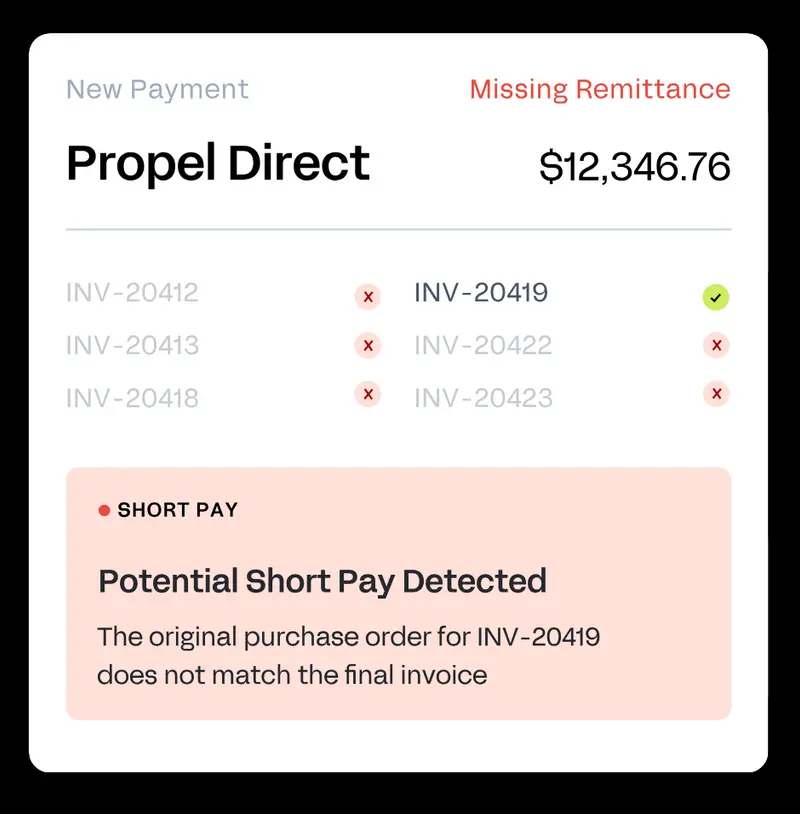
Unapplied cash is usually a matching failure, not a collections failure. A payment arrives without clean remittance data, doesn't match an invoice automatically, and sits in a suspense account inflating your DSO until someone manually tracks it down.
Nearly half of organizations still manage remittance data manually across emails, PDFs, portals, and lockboxes, according to a 2026 NACM and BlackLine survey of credit professionals. AR automation through accounts receivable management systems fixes this gap.
Automating cash application is usually the fastest way to clean up a DSO number that manual matching has quietly overstated for months and prevents overdue payments from piling up in suspense.
A customer approved for credit six months ago isn't the same credit risk today. Payment behavior shifts. Financial health deteriorates. A quarterly or annual review cycle means you find out only after the risk has changed, often only when a payment stops arriving on time.
Automated monitoring uses AI to watch payment patterns and bureau signals continuously. It catches the shift while there's still time to adjust terms or tighten credit limits, before an account hits 60 days overdue.
A deduction that sits unresolved for weeks delays cash. It also means someone researches the same short payment from scratch because the context, invoice, correspondence, and reason code live in three different places.
Fast resolution requires assembling that context automatically instead of hunting for it manually each time a deduction lands. That's what keeps a deduction from becoming a write-off simply because nobody had time to research it before it got forgotten.
A single company-wide DSO number hides problems. If enterprise accounts pay in 25 days and a specific industry segment averages 65, blending them masks the lagging segment. The team reports a solid number while a third of the portfolio worsens.
DSO means more when you segment it by customer, size, or industry.
A customer's credit terms, payment history, and current account status should live in one record, not three separate systems. When onboarding, credit, and AR each hold their own version, discrepancies pile up. Someone finds out the hard way, usually when a collections call references outdated terms.
Connected accounts receivable shares customer context across the full lifecycle so those versions don't drift apart.
Four KPIs show whether these practices are actually working:
Overdue invoices affect roughly 44% of B2B credit sales in North America, according to the 2025 Atradius Payment Practices Barometer. That's the baseline most AR teams are working against, and it's worth measuring your own numbers against it rather than assuming your aging report looks normal because it looks the way it always has.
Individually, these nine practices help. A team adopting a handful will see improvement, but real gains come when systems share data instead of each holding its own customer record. That turns nine separate disciplines into one connected system.
A credit policy that collections doesn't know about. An onboarding record that AR has to re-verify. A cash application tool blind to credit terms. Each gap is where a practice stops working because the adjacent system wasn't built to see it.
Many ERP systems and disconnected accounting software platforms struggle with this integration. Modern AR technology closes those gaps instead of adding another disconnected tool.
Nuvo's accounts receivable platform runs onboarding, credit, and AR on one account. Credit terms stay consistent from approval through collections, and payments match against real-time data, not outdated snapshots.
Pull your own aging report and check it against the nine practices above: which one is missing, and which metric is it quietly dragging down? If you can't tie a specific number to a specific gap, that's the disconnect this list is meant to fix.
See how Nuvo Intelligence runs onboarding, credit, and AR on one platform.