 Nuvo Platform
 Nuvo Intelligence
 Customer Onboarding
 Portfolio Management
 Vendor Onboarding
 Accounts Receivable
 Alcohol & Beverage
 Apparel
 Building Materials
 Chemicals
 Distribution
 Food Service
 Heavy Equipment
 Manufacturing



Loading

A National Association of Credit Management (NACM) credit insights report found that 20% of credit professionals name the internal approval process as their single biggest source of delay in approving net terms, second only to waiting on trade references. For a lot of teams, the hardest part is the manual work between submission and approval: collecting data, verifying it, and routing the applicant to a decision. Automated credit management software, like Nuvo and Bectran, exists to compress that middle ground, but the two platforms get there differently.
Both look similar on paper now. Both run the full order-to-cash cycle: onboarding, credit decisioning, accounts receivable, payments, and collections. But where each platform pulls its intelligence from differs. Nuvo runs every stage on a shared network of verified businesses, so a customer's history elsewhere on the network informs their approval and AR treatment. Bectran runs every stage on configurable modules your team builds and populates inside its own instance.
That difference shapes how much context follows a customer from application to cash, and which platform actually clears your bottleneck.
Nuvo is an AI-native order-to-cash network built on the Trade Graph, a verified network of more than 175,000 businesses. The Trade Graph gives Nuvo Intelligence and Nuvo's AI agents shared context across the full lifecycle:
It's purpose-built for B2B trade credit, and it's used by companies that want the full order-to-cash operation running on one connected system instead of a stack of disconnected tools.
Bectran is also built around the order-to-cash cycle, but lacks the shared network infrastructure:
The platform is aimed at large finance operations that want every credit-to-cash workflow on one system, configurable to their own process.
In summary, Nuvo and Bectran cover a lot of the same lifecycle stages, but take a philosophically different approach. Nuvo's agents draw on a network of businesses that already share verified identity, risk, and payment data in addition to customer-specific policies, bureau data, and other publicly-available sources. Bectran's agents only draw on the policies, bureau connections, and history your team configures inside its own instance..
Both are credit management and accounts receivable software built for B2B trade credit, but they differ across the specific capabilities a credit and AR team weighs most.
Each platform manages onboarding and applications well. The difference is where the data backing the application comes from.
Nuvo treats the application as the first step of onboarding, not the finish line. The customer fills out a digital credit application branded to your business. While they fill it out, Nuvo verifies what they enter, pulls their bank connection, and collects trade references in the background, often against data the customer already provided while onboarding to another supplier on Nuvo's network. By the time the application reaches your queue, the bureau report, the financial data, and the references are attached, so the work left is reviewing the file rather than assembling it.
Nuvo Intelligence and the Onboarding Agent can go a step further and decision the file directly against your credit policy: approving it, rejecting it, or sending it back to the applicant for more information, so a reviewer's queue holds only the files that genuinely need a person's judgment. Once a file is approved, whether by a person or an agent, the customer is created in your ERP with payment methods authorized for AR, without anyone re-keying the data twice.
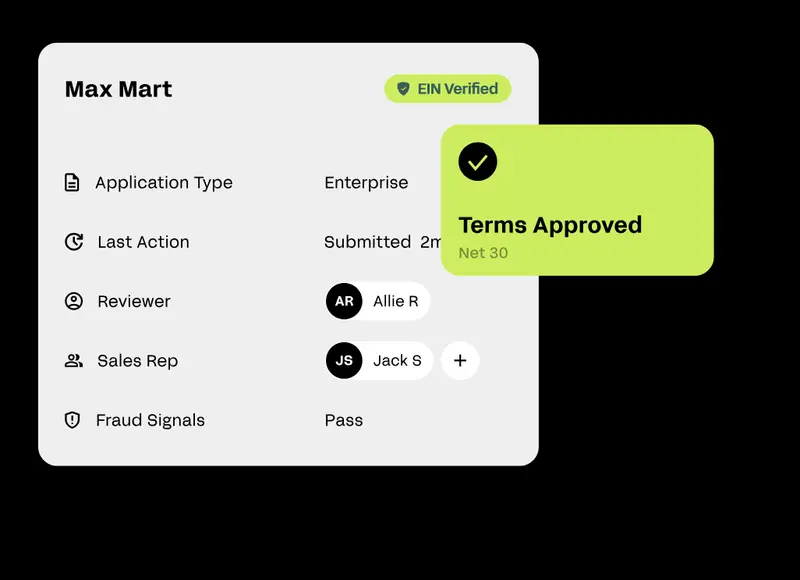
Bectran handles the application with configurable forms, reference automation, and credit scoring pulled from providers like Experian, Equifax, and Dun & Bradstreet, and states its scoring auto-approves up to 90% of low-risk applications. Bectran's decisioning runs on bureau data and the policies your team builds into the platform. Nuvo's Onboarding Agent leverages the same data sources as Bectran, but then layers in a network of 175,000+ verified businesses, so an applicant with existing history elsewhere on the network comes with a lot more context.
Verification is the step that either protects you or hands a fraudster an open account. Nearly 60% of businesses told Experian their fraud losses have climbed over the last year, per its 2025 U.S. Identity and Fraud Report, and catching a bad account at intake costs far less than writing off what it takes with it later.
Nuvo runs verification while the customer fills out the form, so Know Your Business (KYB) checks happen during onboarding, not as a separate compliance task afterward. Before anyone makes a decision, Nuvo has already checked:
The reviewer gets a verified profile and an enforceable agreement before deciding whether to extend credit terms.
Bectran verifies identity and business details too, with built-in fraud detection and audit-ready compliance documentation layered on top of its scoring models. Bectran's verification runs on the bureaus and data sources your team connects. Nuvo's also draws on businesses already onboarded elsewhere on the network. If stopping a bad account at the application stage is your top concern, ask each vendor how they'd catch a business with no history in either system.
Both platforms decide on new applications. They differ in how well they monitor accounts after approval.
Nuvo builds a risk profile the moment an application comes in, with credit reports pulled, financials laid out, and your scorecard applied, so the reviewer isn't waiting on anyone to gather data. Teams make faster credit decisions without loosening their risk standards. After approval, Nuvo's risk monitoring tracks accounts you've already taken on and flags a new tax lien, a legal judgment, a dropping bank balance, or a rising DSO, drawing on banks, bureaus, and your own AR data.
Bectran monitors accounts too, with a live risk dashboard, portfolio heatmaps, and forecast models that flag deteriorating accounts and trigger AR reviews. Because that monitoring runs on data configured inside your instance, ask each vendor how it handles a thin-file account with no trade history, how often the risk data refreshes, and how quickly you'd hear about a change between refreshes.
Both platforms now run cash application and collections in addition to credit, and it's the area that's changed most in the last year.
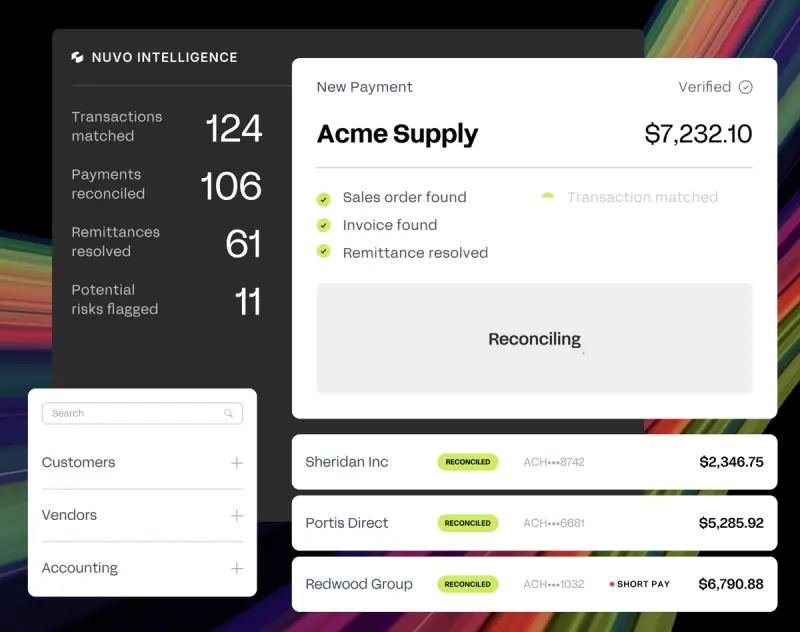
Nuvo's AR Suite runs payments, cash application, and collections on the same account and network that handles onboarding and credit. Customers authorize payment methods at onboarding, pay through a branded portal across ACH, wire, check, or credit card, and Nuvo Intelligence agents reconcile cash to invoices, resolve short pays and deductions, and run collections outreach using the same risk and payment context built earlier in the relationship. Every payment lands in one unified bank account¹, so nothing gets reconciled across separate lockboxes and processors.
Bectran's accounts receivable and collections modules run cash application with OCR-based remittance matching, behavior-based collections strategies, order-hold management, and third-party placement when an account moves to outside collections. The work runs on the policies, portfolios, and history your team configures inside Bectran, module by module.
If a credit and AR platform doesn't connect to your ERP, your team ends up maintaining customer data in two places and re-entering it by hand.
Nuvo has a native NetSuite SuiteApp, plus webhooks and API connections to all major ERPs, enabling Nuvo to create the new customer in your ERP directly from Nuvo. It also connects to 16,000+ banks for live balances and matches bureau reports to the application at submission.
Bectran connects to more than 3,000 ERPs, CRMs, bureaus, and payment processors, including SAP, Oracle, and Microsoft Dynamics, syncing customer records, credit limits, and payment history across them. That breadth suits teams running several systems across multiple entities or regions.
Either way, ask the same question: Does it integrate with your stack out of the box, or does it need custom development to fit?
Nuvo’s deployment specialists handle the setup work. You map your credit policy rules and connect your systems before you dig in. But because the AR Suite runs on the same account, network, and agents already in place for onboarding and credit, extending into payments and collections doesn't require a second implementation project.
Bectran spans a wide set of modules across credit, AR, and collections, so there's more to configure before all of it runs. Migrating off a legacy system or building non-standard credit policies is possible, but implementation usually requires IT across each module you turn on.
Credit managers interviewed by NACM in 2024 described typical new-account approvals taking one to three days once tax verification and credit review are factored in. The faster a platform reaches a working approval flow, the sooner it cuts that time.
Nuvo fits teams whose bottleneck spans the order-to-cash cycle, not just the application: getting a new customer approved and purchase-ready fast, then keeping AR, payments, and collections running off the same data instead of stitching together separate tools. If your credit team is losing deals to slow approvals, manual reference checks, or handoffs between disconnected systems as customers move into billing, Nuvo is built for that gap.
It's strongest for mid-market and enterprise B2B companies, particularly distributors and manufacturers in industries like building materials, chemicals, and food and beverage, that want:
Bectran fits finance teams running high volume across many entities, regions, or currencies that want deep configurability within each stage of credit-to-cash. If your priority is standardizing credit, AR, and collections on one platform while keeping tight control over every module's setup, Bectran's flexibility is the reason to look at it.
That flexibility comes with a cost. It suits large finance teams with the resources for a comprehensive implementation and the appetite to configure many modules rather than adopt a network's defaults. Established enterprises already invested in SAP, Oracle, or Microsoft Dynamics, with IT capacity for configuration, are the teams most likely to absorb that lift. For a team that wants a shared network doing the verification and context-building for them, that configuration becomes overhead instead.
Start with where your team's time actually goes, then match the platform to the bottleneck.
Whichever way you lean, make each vendor walk through your most complicated scenario, not their cleanest demo. Ask how each handles a thin-file applicant, what happens when a healthy account starts showing stress, and whether AR and collections run on the same customer record as onboarding and credit, or a separate one.
If your hardest problem spans onboarding, credit, and the cash that follows, that's the network Nuvo is built around. Talk to the Nuvo team to walk through your onboarding-to-cash flow and see how it handles your real applications.
¹ Nuvo is a financial technology company, not a bank. Bank account and banking services provided by Column N.A., Member FDIC.